E-commerce
 Marketing
 Finance
 Product Engineering
 Data & Engineering Teams
 Sales & GTM
 Pricing & Competitive Research
 Operations & Monitoring
The biggest seed rounds of 2026 went to research, not product
Abby Grills· CEO, RiveterPublished · Updated · 9 min read
TL;DR
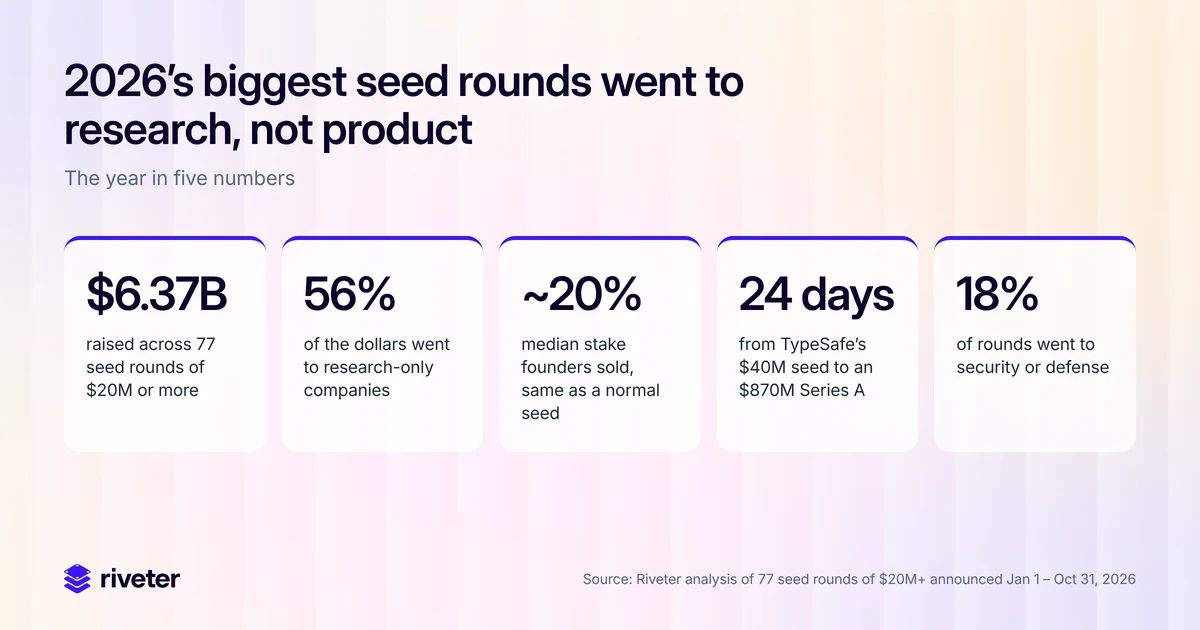
- 77 seed rounds of $20M or more were announced between January 1 and October 31, 2026. Together they raised $6.37B, and the median round was $40M.
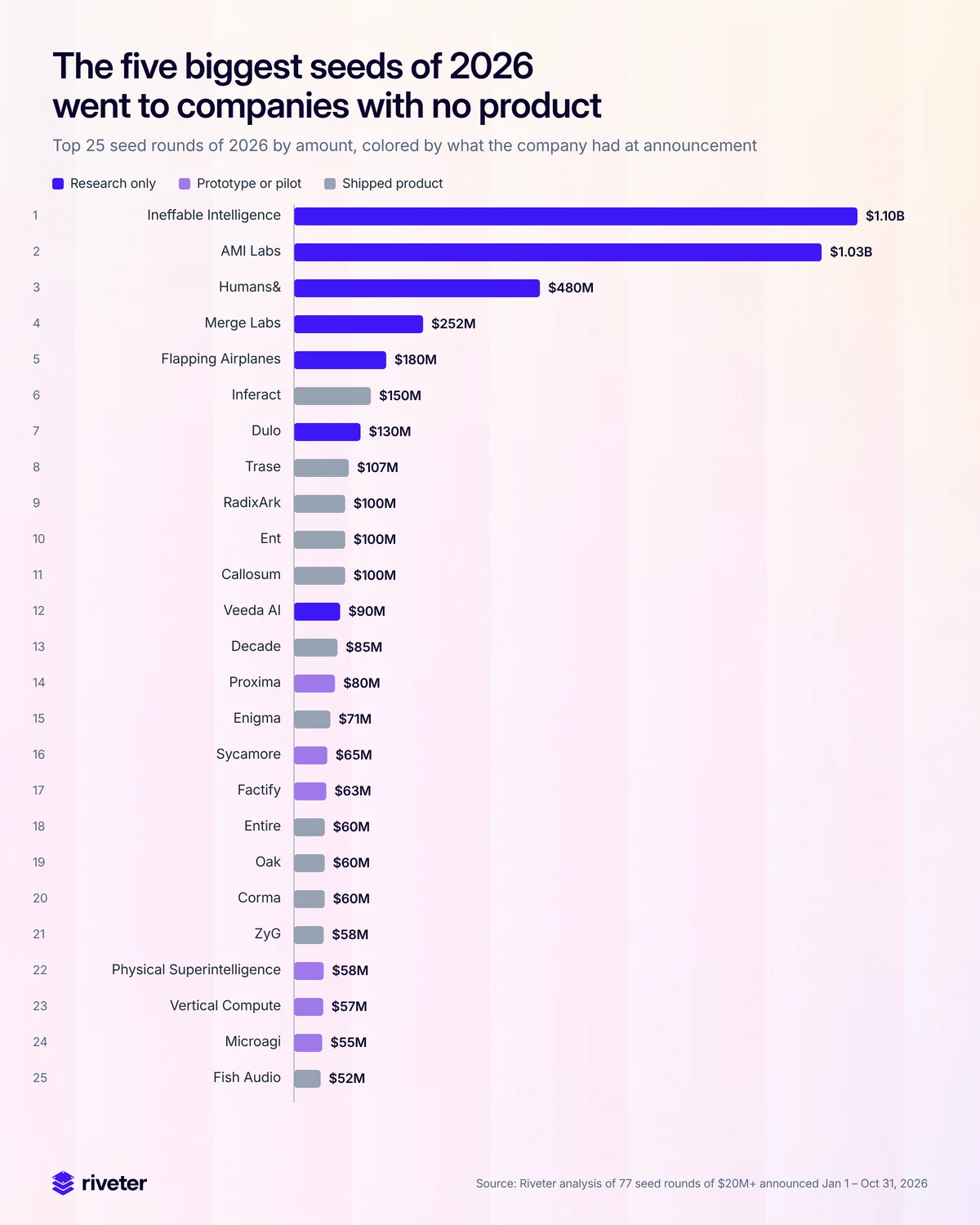
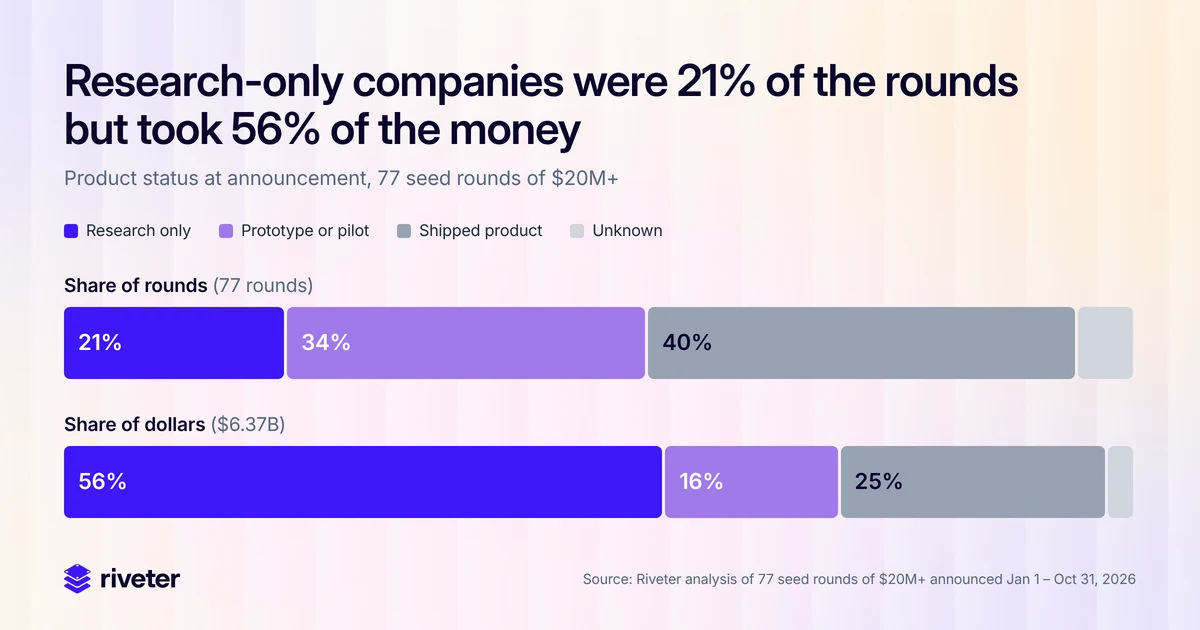
- The biggest checks bought research, not product. Research-only companies were 21% of the rounds but took 56% of the dollars. The five largest seeds of the year all went to companies with nothing to sell yet.
- Founders still sold about a fifth of the company, which is the typical dilution in a seed round. What changed was the price, not the stake.
- For some, the seed was just a down payment on a much bigger round. TypeSafe went from a $40M seed at a $200M valuation to an $870M Series A at $7.5B in 24 days.
- Software raised bigger seeds than hardware. Capital-light applied software had a $50M median seed; robotics, chips, nuclear and space had $34M.
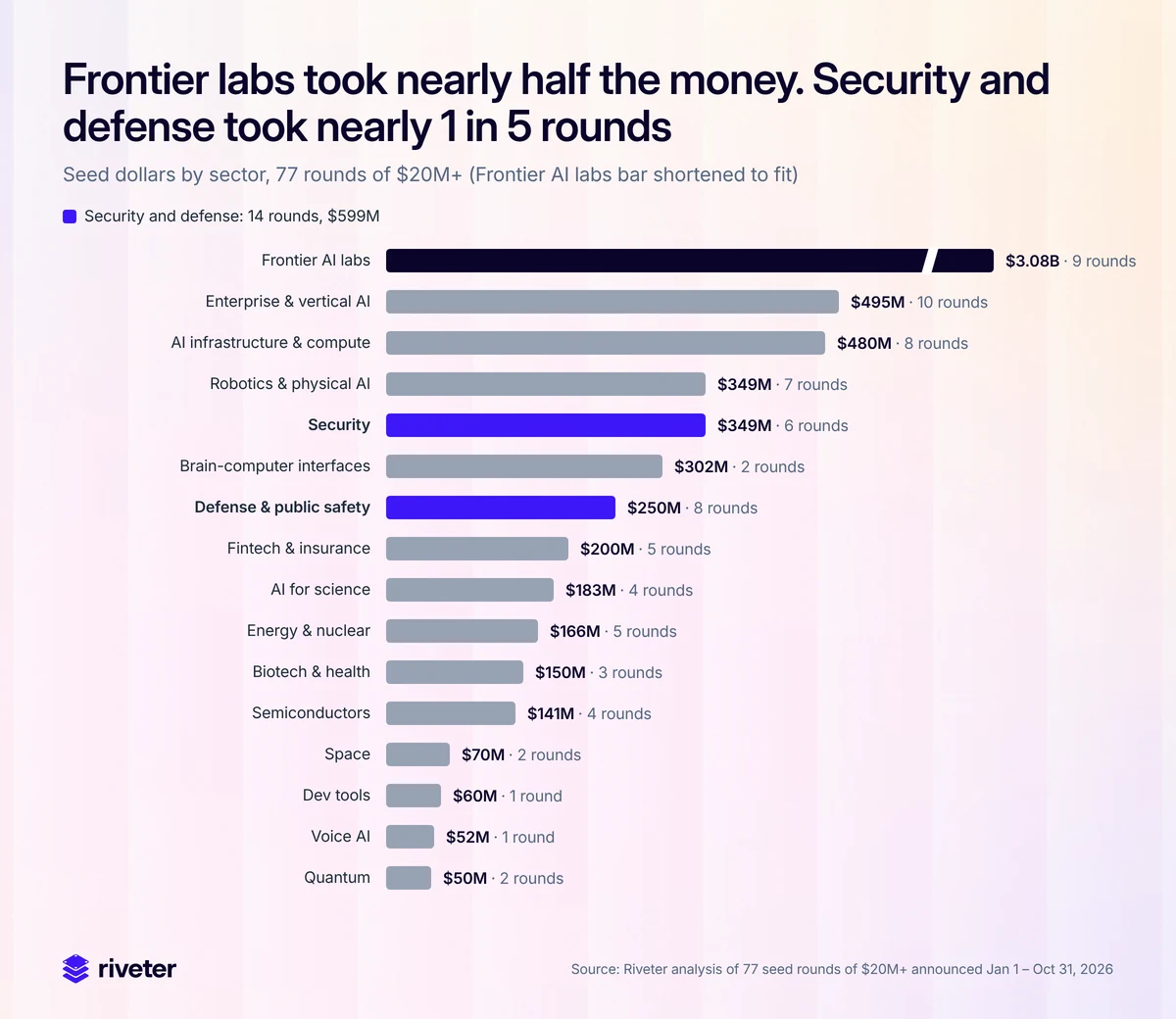
- Nearly 1 in 5 of the year’s biggest seeds went to security or defense: 14 rounds, $599M.
Seed doesn’t mean small anymore
In March, Yann LeCun’s AMI Labs raised a $1.03B seed round. Seven weeks later, AlphaGo’s lead researcher David Silver topped it: his London lab, Ineffable Intelligence, raised $1.1B, the largest seed round in European history. Neither company had a product.
We wanted to know whether these were outliers or the shape of the year. So we used Riveter to compile every seed round of $20M or more announced in 2026 through October 31. Then we enriched each one with its lead and participating investors, founder backgrounds, valuation, pre-seed history, follow-on rounds, product status at launch and headcount. Every amount was checked against its source.
The result is 77 rounds and $6.37B. The distribution is a barbell:
- The top three rounds (Ineffable, AMI and Humans&) account for 41% of all the money.
- Most rounds are big, not giant. 52 of the 77 raised $50M or less, and the median is $40M.
So there are really two stories here. One is a handful of research labs raising like late-stage companies. The other is a much larger group of “big seeds” that would have been a Series A a few years ago.
The biggest checks bought research, not product
Riveter tagged each company by what it had at launch: a shipped product, a prototype or pilot, or research only. The money skews hard toward the companies with the least to show.
| Status at launch | Rounds | Total raised | Share of dollars |
|---|---|---|---|
| Research only | 16 (21%) | $3.60B | 56% |
| Prototype or pilot | 26 (34%) | $1.03B | 16% |
| Shipped product | 31 (40%) | $1.59B | 25% |
| Unknown | 4 (5%) | $0.15B | 2% |
The gap is widest at the top. Eleven rounds were $100M or more. The six research-only companies among them raised $3.17B. The five with a shipped product raised $557M.
Bets against the current recipe
The research-only mega-rounds share a thesis: today’s way of building AI isn’t the whole answer.
- Ineffable Intelligence ($1.1B): systems that learn from experience, without human-generated data.
- AMI Labs ($1.03B): world models that understand the physical world, not just text.
- Flapping Airplanes ($180M): training methods that need far less data.
- Adaption Labs ($50M): models that keep learning after deployment.
- Dulo ($130M): foundation models for hardware engineering and design.
Investors aren’t paying for a product roadmap. They’re paying for a credible shot at the next breakthrough, and for the people most likely to find it.
Pedigree is the collateral
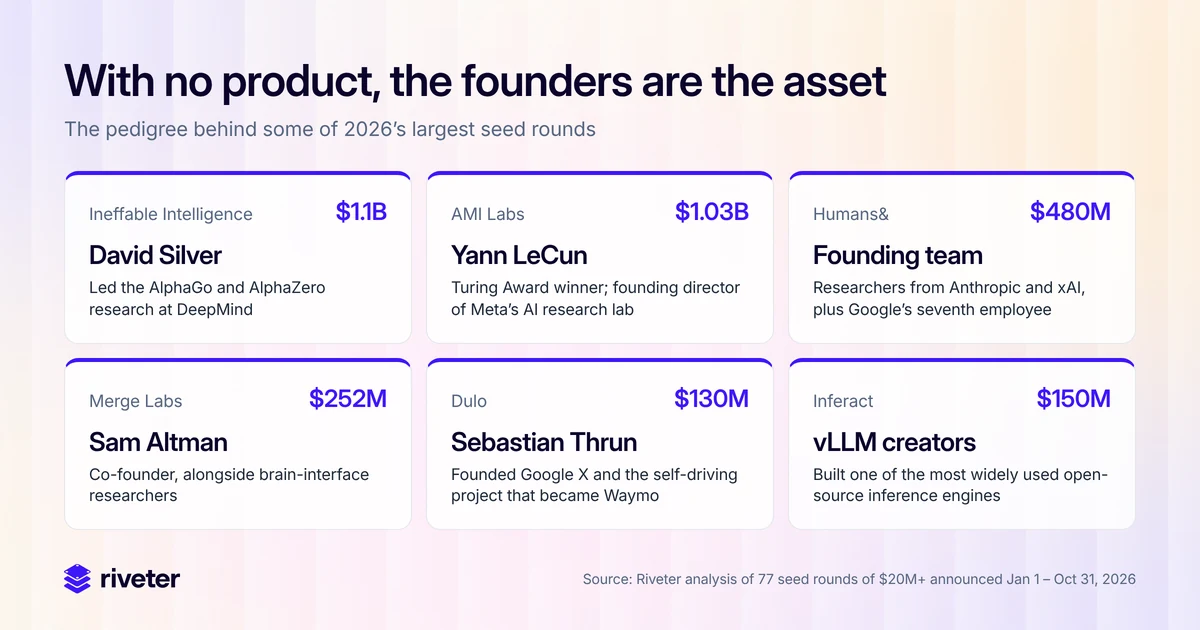
With no product to evaluate, the founders are the asset. The top of the leaderboard reads like an AI hall of fame:
| Company | Seed | Founder credential |
|---|---|---|
| Ineffable Intelligence | $1.1B | David Silver, lead researcher on AlphaGo and AlphaZero at DeepMind |
| AMI Labs | $1.03B | Yann LeCun, Turing Award winner and founding director of Meta’s AI research lab |
| Humans& | $480M | Researchers from Anthropic and xAI, plus Google’s seventh employee |
| Merge Labs | $252M | Co-founded by Sam Altman |
| Dulo | $130M | Sebastian Thrun, founder of Google X and of the self-driving project that became Waymo |
| Inferact / RadixArk | $150M / $100M | Creators of vLLM and SGLang, two of the most widely used open-source inference engines |
| Entire | $60M | Thomas Dohmke, former CEO of GitHub |
Needs capital vs. can command it
The research labs have obvious reasons to raise this much. Training runs can cost hundreds of millions in compute before there’s anything to sell. Top researchers command big-tech-level pay after the 2025 talent wars. And investors who missed OpenAI and Anthropic are paying up for a shot at the next one.
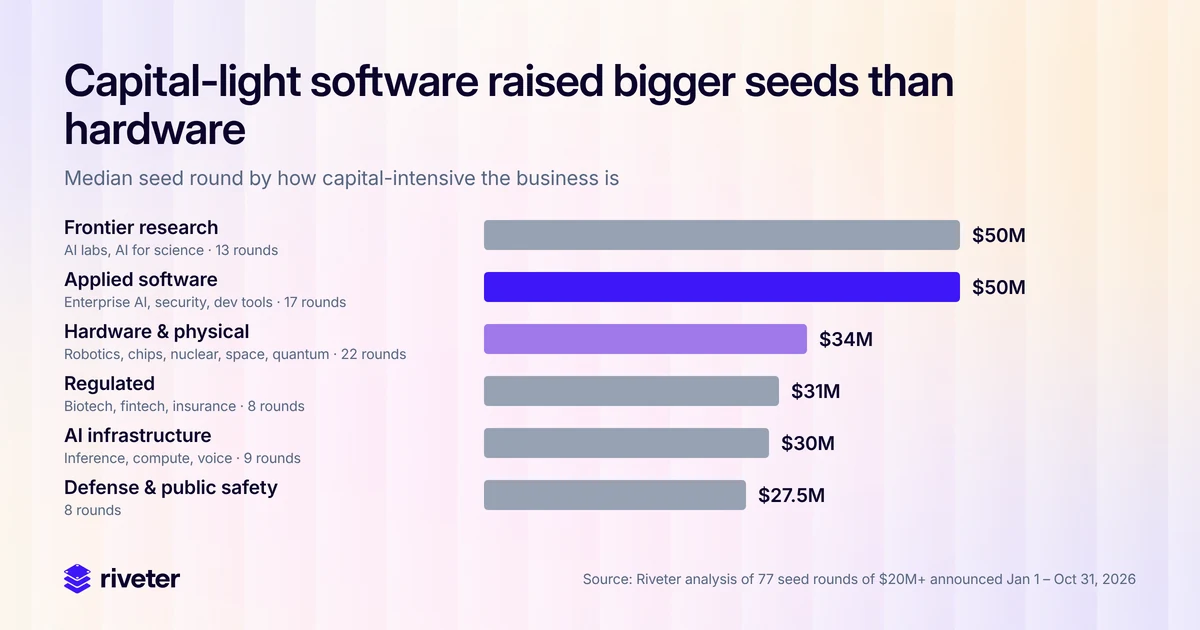
But when we grouped every round by how capital-intensive the business is, the data didn’t line up the way we expected.
| Capital profile | Rounds | Total raised | Median seed |
|---|---|---|---|
| Frontier research (AI labs, AI for science) | 13 | $3.26B | $50M |
| Applied software (enterprise AI, security, dev tools) | 17 | $904M | $50M |
| Hardware and physical (robotics, chips, nuclear, space, quantum, brain-computer interfaces) | 22 | $1.08B | $34M |
| Regulated (biotech, fintech, insurance) | 8 | $350M | $31M |
| AI infrastructure software | 9 | $532M | $30M |
| Defense and public safety | 8 | $250M | $28M |
Capital-light software raised bigger median seeds than the companies building reactors, chips and robots. That points to two different kinds of mega-seed:
- Needs it. The money is the cost of making the product exist at all: compute, prototypes, fabrication, clinical work, regulatory capital. Think Apollo Atomics and Bluecore (nuclear), TeRAM (AI memory chips) or Proxima (drug discovery).
- Can command it. Pedigree plus a land grab. Trase ($107M), Ent ($100M), Sycamore ($65M), Entire ($60M), Oak ($60M) and ZyG ($58M) are software companies led by repeat founders or senior operators, and most shipped at launch. The money doesn’t make the product possible. It buys speed and distribution.
Same fifth of the company, a very different price
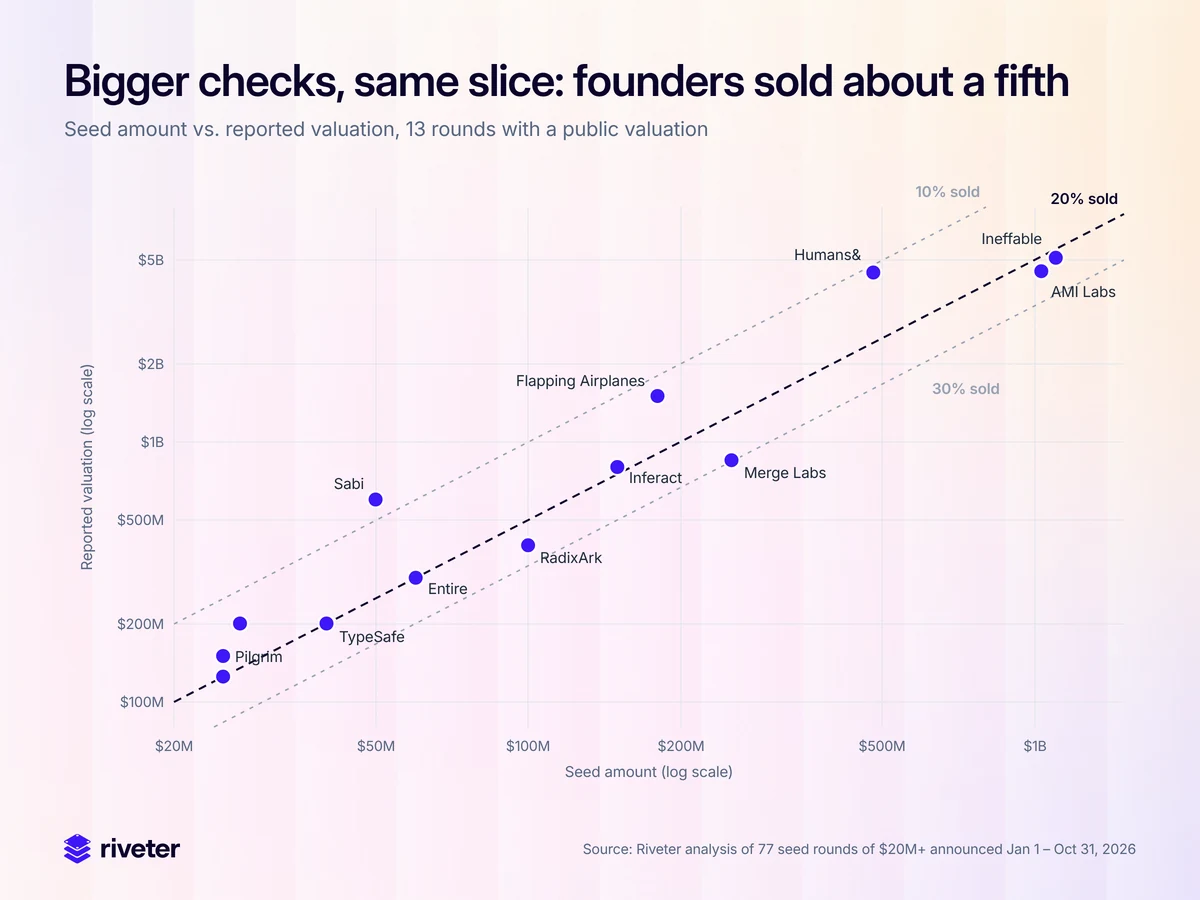
You might expect founders raising $100M+ at seed to give up much more of their company. They didn’t.
13 rounds in our dataset have a publicly reported valuation. Across them, founders sold a median of about 20%, the same as a typical seed. A few examples:
- Ineffable Intelligence: $1.1B at $5.1B, about 22%
- Entire: $60M at $300M, 20%
- TypeSafe: $40M at $200M, 20%
- Humans&: $480M at $4.48B, about 11%
The valuations scaled with the check sizes. The ownership investors bought didn’t move.
The seed is just the first check
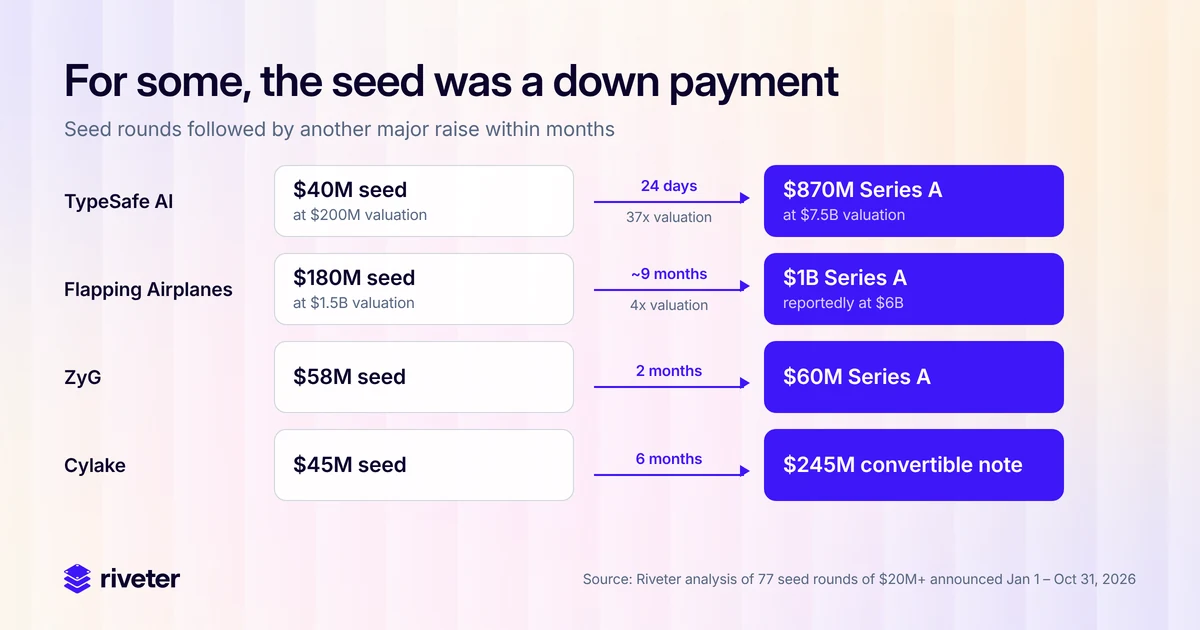
For the top of this list, the seed isn’t the start of a long fundraising journey. It’s the first tranche of a much bigger one.
| Company | Seed | Next round | Time between |
|---|---|---|---|
| TypeSafe AI | $40M at $200M | $870M Series A at $7.5B, about 37x the seed valuation | 24 days |
| Flapping Airplanes | $180M at $1.5B | $1B Series A, reportedly at $6B | ~9 months |
| ZyG | $58M | $60M Series A | 2 months |
| Cylake | $45M | $245M convertible note | 6 months |
Others came back for more seed money instead. Hang Ten Systems followed its $32M seed with a $53M “Seed II” three months later.
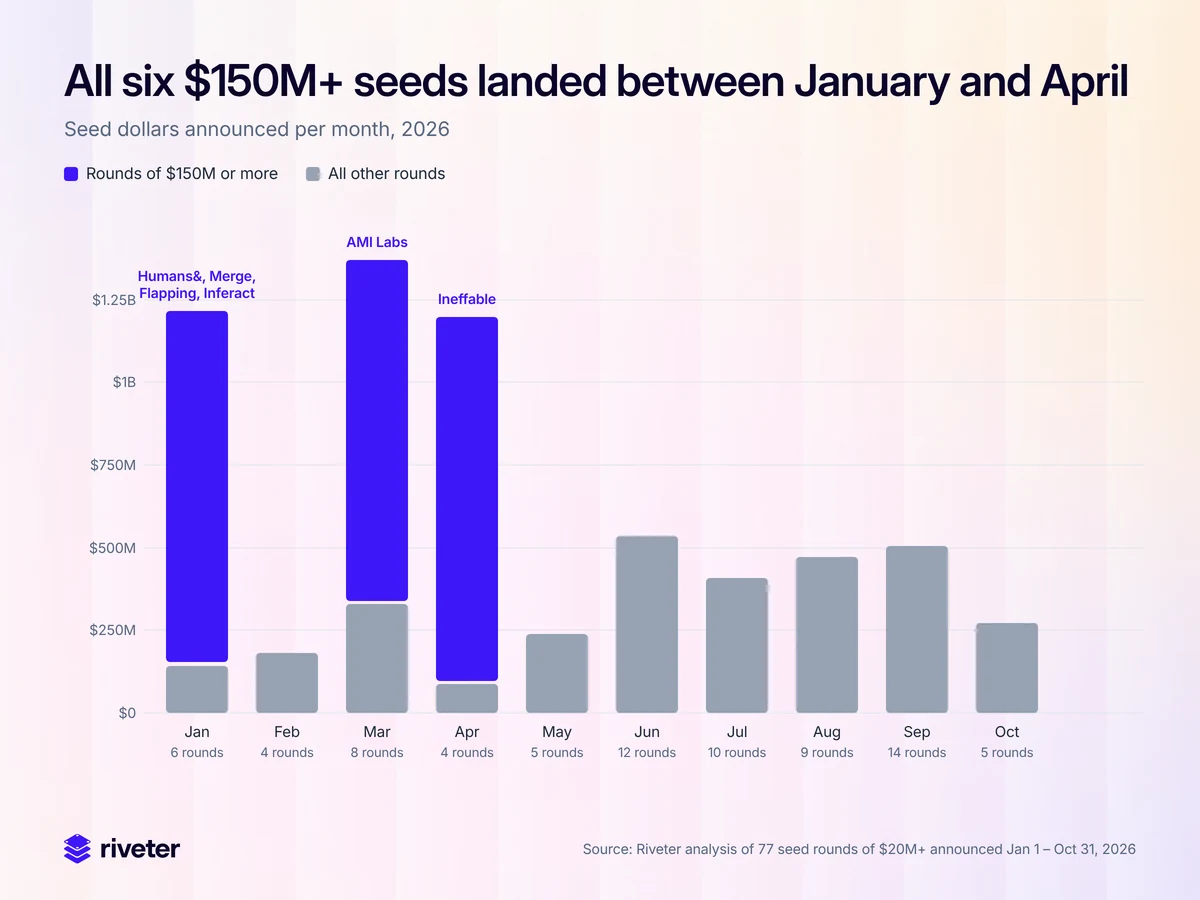
There’s also a timing pattern. All six seeds of $150M or more were announced between January and April. The rest of the year still produced big rounds, including Dulo’s $130M at the end of October, but nothing at the very top. One reading: the biggest money is skipping the seed label and going straight to Series A.
Where the money went
Outside the frontier labs, three clusters stand out.
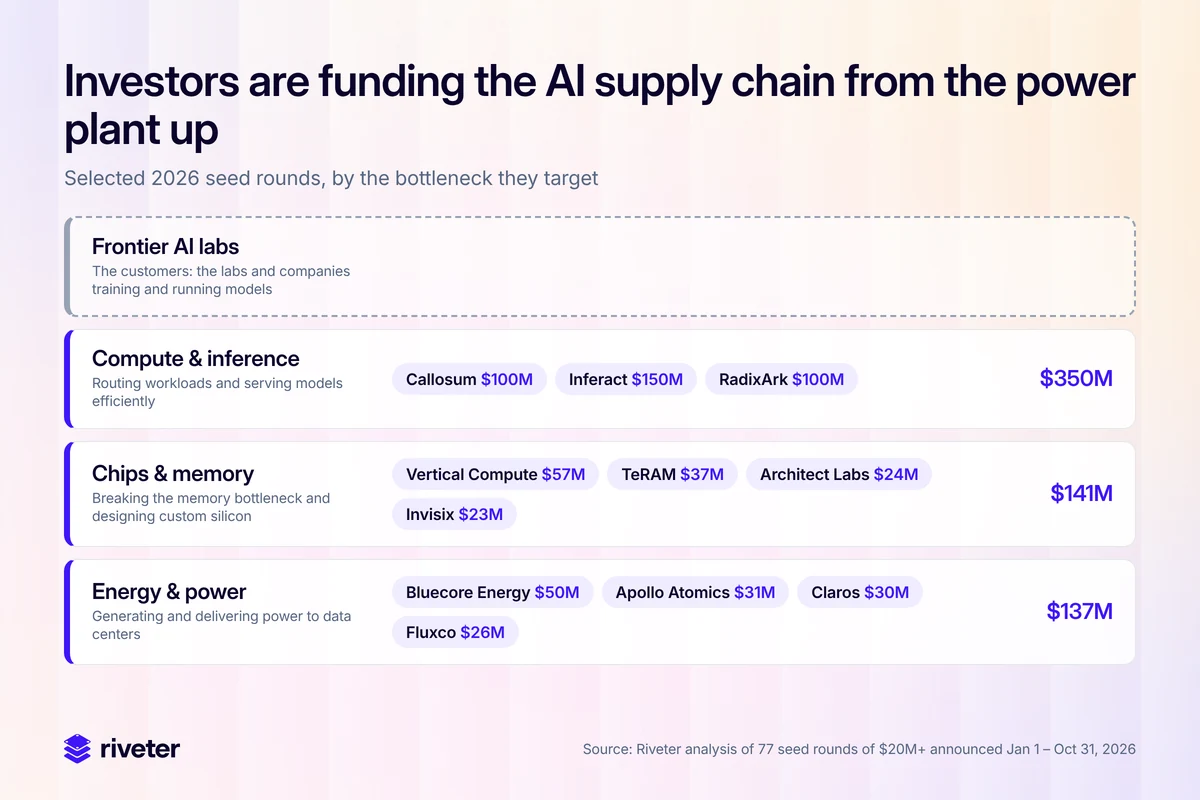
1. The AI supply chain, funded from the power plant up
Investors are funding every bottleneck between electricity and a working model:
- Energy and power: Apollo Atomics ($31M) and Bluecore Energy ($50M) are building smaller nuclear reactors. Claros ($30M) cuts power loss inside data centers. Fluxco ($26M) helps buyers source grid transformers, which are in short supply.
- Chips and memory: TeRAM ($37M) and Vertical Compute ($57M) attack AI’s memory bottleneck. Architect Labs ($24M) uses AI to design custom chips. Invisix ($23M) measures chip structures that can’t be seen today.
- Compute and inference: Callosum ($100M) routes AI workloads to the best-suited chips. Inferact ($150M) and RadixArk ($100M) commercialize open-source inference engines.
2. Open source became companies
Three of the year’s biggest seeds went to teams that first built popular open-source projects: vLLM became Inferact ($150M), SGLang became RadixArk ($100M), and Fish Speech became Fish Audio ($52M). That’s $302M for teams that proved demand before they had a company.
3. Security and defense: nearly 1 in 5 rounds
14 of the 77 rounds, worth $599M, went to cybersecurity or defense.
- Security, rebuilt for AI agents: Ent ($100M), Oak ($60M), Corma ($60M), AIR Security ($50M), Cylake ($45M) and JetStream ($34M). Four of the six (Ent, Oak, AIR and JetStream) are built around the same problem: AI agents now act inside companies, and someone has to govern what they can access and do.
- Defense and public safety: Onodrim Industries ($47M), Pax ($40M), Arkenstone Defense ($35M), Agon ($30M), Traysar ($25M), Furientis ($25M), Pilgrim ($25M) and INLEAP Photonics ($23M). They range from low-cost missile interceptors to underground autonomous systems to sensors that detect airborne biological threats.
Also notable
- Brain-computer interfaces: Merge Labs ($252M) and Sabi ($50M), which is putting a brain-signal sensor inside a baseball cap.
- AI for science: Physical Superintelligence ($58M), Inherent ($50M), Radical Numerics ($50M) and Transfyr ($25M).
- Quantum and space: ZuriQ, Q-Factor and PAVE Space.
Who wrote the checks, and where
The lead investors
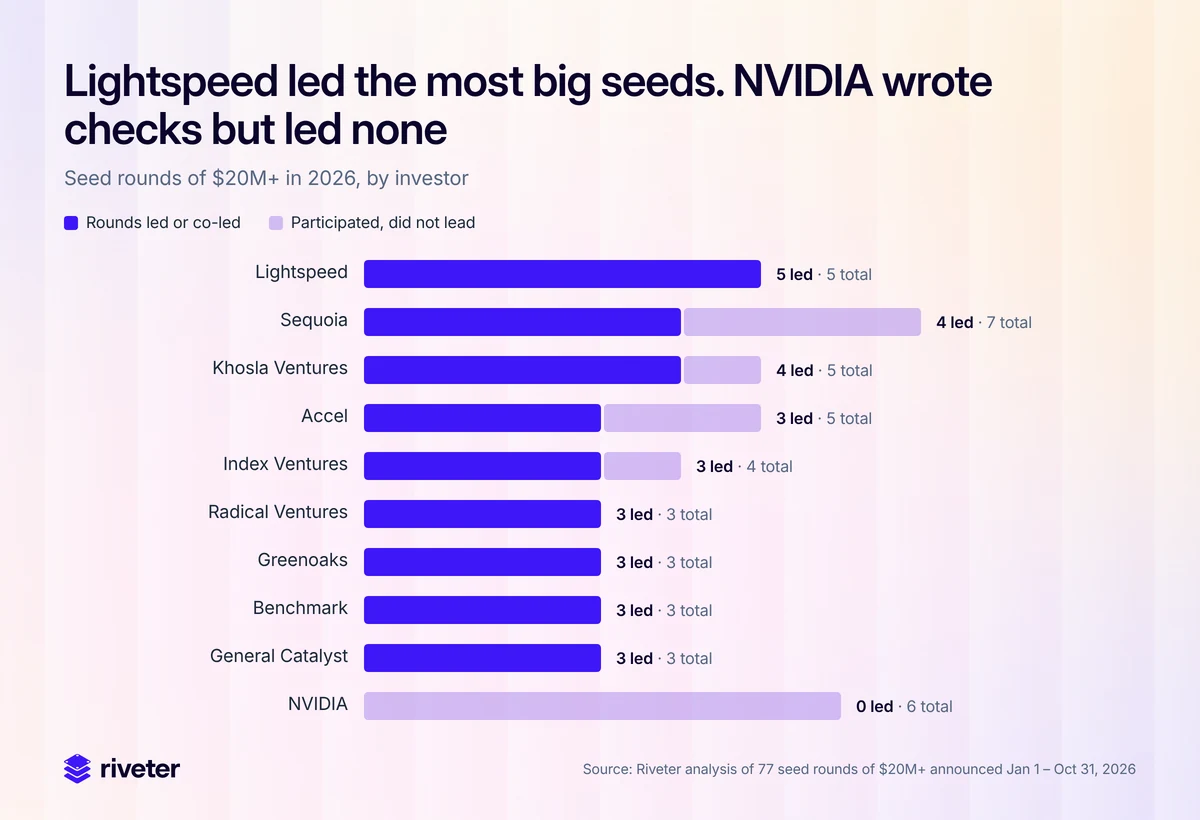
Counting only the rounds a firm led or co-led gives a different picture than counting every check:
- Lightspeed led the most: 5 rounds (Ineffable, Inferact, Sycamore, ZyG and Harmony).
- Sequoia and Khosla led 4 each. Sequoia participated in 7 rounds overall.
- Accel, Index, Radical Ventures, Greenoaks, Benchmark and General Catalyst led 3 each.
- NVIDIA (directly or through NVentures) invested in 6 rounds and led none.
Three patterns worth noticing
- The Brazil pairing. Brazil’s two big seeds, Decade ($85M, the largest seed in Latin American history) and Pax ($40M), were both led by Greenoaks and Benchmark.
- Insider rounds. Seven companies were incubated by, or co-founded with, the firm that led their round. Red Cell Partners did it twice (Trase and Claros, which share a co-founder). Empirik was incubated at Sequoia. Noetive’s co-founder is Eclipse’s chief AI officer, and Eclipse led. Fluxco, Slingshot Insurance and Hypha follow the same pattern.
- Governments write seed checks now. The UK Sovereign AI Fund invested in Ineffable and Callosum. France’s Bpifrance is in AMI. The Korea Development Bank is in Config.
Where the companies are
| Region | Rounds | Total raised |
|---|---|---|
| United States | 50 | $3.07B |
| Europe | 17 | $2.75B |
| Israel | 6 | $315M |
| Brazil | 2 | $125M |
| Canada and South Korea | 2 | $117M |
Europe’s total comes mostly from Ineffable and AMI, but the region also set national records: Microagi’s $55M is the largest seed ever raised in Germany. Israel’s six rounds were mostly security.
The bill comes later
A mega-seed solves today’s problems and creates tomorrow’s. The main ones:
- The next round has a very high bar. A company valued at $5B on day one needs to be worth a lot more before its Series A, or it’s raising a down round. Very few companies have grown into that kind of price without revenue.
- Smaller exits stop working. A company that raised $480M at $4.5B can’t sell for $500M without leaving employees with little or nothing. Acqui-hires and modest acquisitions are effectively off the table.
- Investor preferences pile up. Investors usually get their money back before anyone else. With hundreds of millions in preferred stock, founders and employees only do well if the outcome is enormous.
- Strategic and sovereign money comes with strings. Chip makers may expect to see their money come back as compute spend. Sovereign funds bring hiring and location expectations.
- The employee equity problem. As covered above, if the company doesn’t grow into its price, everyone who joins later is underwater.
What “seed” means now
The label is stretching in every direction:
- Seed is often not the first round. 19 of the 77 companies had a confirmed pre-seed, several around $10M (Trase, Factify, Callosum, Bluecore). That’s what a seed round used to be.
- Headlines bundle rounds together. Corridor’s “$25M seed” is a $9M pre-seed plus a $16M seed. Agon’s $30M is a $7M pre-seed plus a $23M seed.
- Older companies raise “seeds” too. TeRAM was founded in 2018, Proxima in 2019 and The Biological Computing Co. in 2021.
- Some “seeds” are top-ups. We excluded several rounds announced as seeds that were really extensions of an earlier seed, plus two holding companies that used the label.
Methodology
- Scope: seed rounds of $20M or more, announced January 1 to October 31, 2026.
- Amounts: the company’s announced headline amount, converted to US dollars where needed. Equipment financing included where it was part of the announced round.
- Excluded: extensions or top-ups of earlier seeds (Gradium, AheadComputing, Terra Industries), rounds with no separable seed amount (Hemispheric, NewCore, Lys Therapeutics), and holding companies using the seed label (TeddyHoldings.AI, Orange Juice).
- Valuations: only publicly reported figures, 13 rounds. Most reports don’t say whether they’re pre- or post-money.
- Product status: based on what the company had at announcement: research only, prototype or pilot, or shipped.